


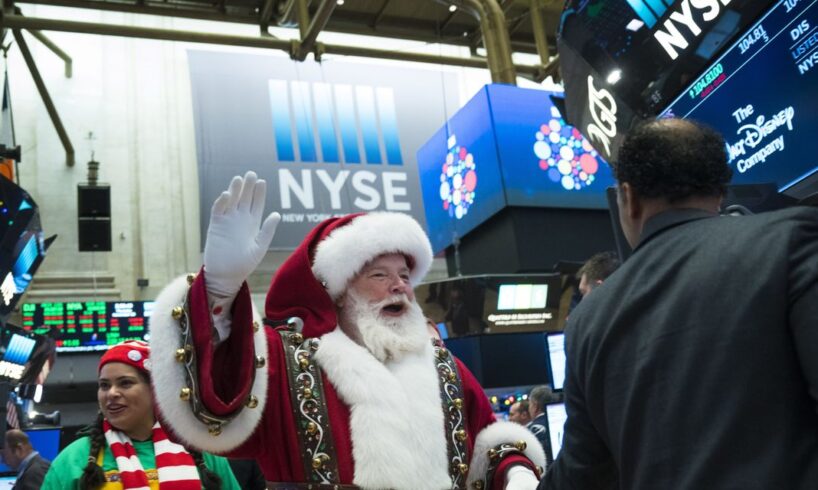
Santa Claus is handing out gifts on Wall Street.
The so-called Santa Claus rally that tends to materialize in the U.S. stock market in the final week of December and the first two trading sessions of the new year, is off to its best start since 2000-01, when the market gained 5.7% over the period, according to Dow Jones Market Data.
Dow Jones Market Data
In fact, in the eight occasions since 1929 when the index has gained at least 1% to start that seven-session trading period near the end of year, the Santa Claus rally has produced a gain 100% of the time, with an average gain of 3.3%.
On Monday, the S&P 500
SPX,
+1.38%
closed in record territory, up around 1.4%, with the session technically marking the start of the seasonal period referred to as a Santa Claus rally; when gains hold up, the stock market tends to perform well, the data show.
The upbeat mood to start the final week of trading in 2021 was helping to lift the Dow Jones Industrial Average
DJIA,
+0.98%
and the Nasdaq Composite Index
COMP,
+1.39%,
with even higher-risk assets such as bitcoin
BTCUSD,
-0.06%
being driven upward to start the week.
Sign up for our Market Watch Newsletters here.
Read: If Santa Claus doesn’t come to Wall Street in December, the Grinch hits the stock market in January, history says
How does the market perform for the rest of January?
January, on average, tends to end higher, with a mean gain of 2.94% and median rise of 3.7%, when the S&P 500 has started the Santa Claus rally period with an advance of at least 1%.
Check out: Merry Christmas, Wall Street! But there’s no New Year’s Day holiday for the stock market this year—here’s why.
The Santa Claus rally trend was first identified by Yale Hirsch, the founder of the Stock Trader’s Almanac, which is now run by his son Jeff.
Hirsch was known for saying that “if Santa…
..